
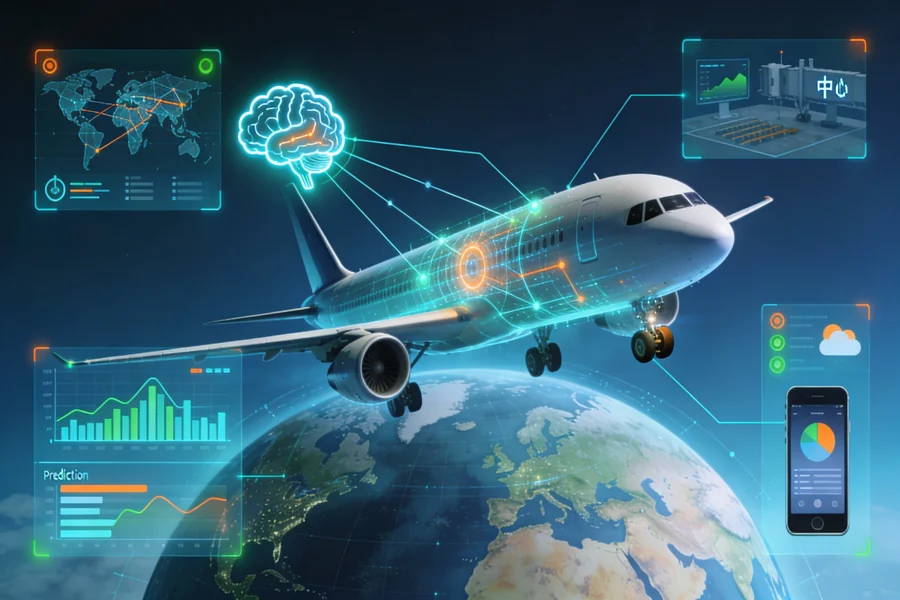
The aviation industry is increasingly turning to artificial intelligence to strengthen operational safety, improve efficiency, and reduce the risk of human error. As airlines manage growing passenger volumes, more complex flight operations, and stricter regulatory requirements, the ability to detect and respond to potential risks in real time has become a critical priority. Industry forecasts suggest that the global market for AI in aviation is expected to surpass billions of dollars by 2027, driven largely by investments in predictive maintenance, intelligent monitoring systems, and AI-powered operational analytics.
Airlines and aviation companies are investing heavily in predictive technologies because traditional reactive approaches are no longer sufficient in a fast-moving and data-intensive environment. AI systems can analyze massive volumes of operational, maintenance, weather, and flight data far faster than humans, identifying anomalies and risk patterns before they escalate into serious issues. From predicting equipment failures to assisting pilots with real-time decision support, AI enables more proactive and informed safety management.
AI also plays a growing role in preventing flight-related risks through continuous monitoring and automated analysis. Machine learning models can detect irregular engine behavior, identify unsafe operational trends, optimize flight routes around severe weather, and improve air traffic coordination. By turning real-time data into actionable insights, aviation organizations can reduce delays, improve safety outcomes, and create a more resilient and efficient operational ecosystem for the future.
Predictive Analytics for Risk Detection and Prevention
Predictive analytics is transforming aviation safety by enabling airlines and aviation companies to identify potential risks before they become operational problems. Using artificial intelligence and machine learning, modern systems can process enormous volumes of historical and real-time flight data, including aircraft performance metrics, maintenance records, weather conditions, pilot reports, and air traffic information. This allows operators to detect patterns, anomalies, and early warning signs that would be difficult for humans to recognize manually.
One of the most valuable applications of predictive analytics is equipment failure prevention. AI-powered systems continuously monitor engines, avionics, hydraulic systems, and other aircraft components to identify abnormal behavior or performance degradation. Instead of relying solely on scheduled maintenance, airlines can adopt predictive maintenance strategies that address issues before failures occur. This reduces unplanned downtime, improves aircraft availability, and significantly lowers the risk of in-flight technical problems.
Predictive technologies also play a critical role in weather forecasting, turbulence prediction, and route optimization. AI models analyze meteorological data, historical flight paths, and real-time atmospheric conditions to help pilots and operations teams avoid hazardous weather and turbulence zones. These systems can recommend safer and more fuel-efficient routes, reducing delays, improving passenger comfort, and minimizing operational disruptions caused by changing weather conditions.
Machine learning further enhances maintenance planning and operational decision-making by reducing dependency on manual analysis and human judgment alone. AI systems can prioritize maintenance tasks, forecast component lifespan, and automate risk assessments based on continuously updated operational data. This not only improves maintenance efficiency but also reduces the likelihood of human error in safety-critical processes.
Key benefits of predictive analytics in aviation include:
- Early detection of technical and operational risks
- Reduced aircraft downtime through predictive maintenance
- Improved flight safety and operational reliability
- Better turbulence and severe weather avoidance
- More efficient route planning and fuel optimization
- Reduced human error in maintenance and operational workflows
- Enhanced regulatory compliance through data-driven monitoring
As aviation operations become more data-intensive, predictive analytics is evolving into a core component of modern flight safety strategies. By turning real-time and historical data into actionable insights, AI enables airlines to move from reactive problem-solving to proactive risk prevention, creating a safer, more efficient, and more resilient aviation ecosystem.
AI-Powered Pilot Assistance and Decision Support Systems
AI-powered pilot assistance systems are becoming an important layer of support in modern aviation, enhancing situational awareness and helping flight crews make faster, more informed decisions. Rather than replacing pilots, these systems act as intelligent copilots that process large volumes of flight data in real time and provide actionable insights during all phases of flight. This includes monitoring aircraft performance, analyzing environmental conditions, and detecting potential risks before they escalate.
One key application is AI copilots and intelligent cockpit assistance tools, which continuously evaluate flight parameters such as altitude, speed, fuel consumption, and system health. These tools can highlight anomalies, suggest corrective actions, and support pilots during complex or high-pressure situations. In critical flight conditions—such as sudden weather changes, technical irregularities, or air traffic congestion—AI systems can deliver real-time recommendations to improve safety and operational stability.
Modern systems also integrate voice recognition and automated alert mechanisms to improve communication and reduce cockpit workload. Pilots can interact with onboard AI using natural language commands, receiving instant updates or guidance without needing to manually navigate complex interfaces. Automated alerts further ensure that important safety warnings are delivered clearly and immediately, reducing response time in emergencies.
The core value of AI in this context lies in enhancing, not replacing, human decision-making. By combining machine-speed data analysis with pilot expertise, airlines achieve faster, more accurate operational responses while maintaining full human control over the aircraft. This collaboration helps reduce cognitive load, minimize human error, and strengthen overall flight safety across increasingly complex aviation environments.
Real-Time Monitoring Technologies in Modern Aviation
Real-time monitoring technologies are transforming modern aviation by enabling continuous visibility into aircraft performance, air traffic conditions, and operational safety. Through advanced sensor networks and AI-powered analytics, airlines can detect issues as they emerge, respond faster to anomalies, and maintain safer and more efficient flight operations. This shift from periodic checks to continuous monitoring significantly improves reliability and reduces the risk of in-flight disruptions.
A key component of this ecosystem is aircraft health monitoring systems, which use embedded sensors to track structural integrity, system performance, and onboard conditions throughout a flight. These systems feed data into AI-driven platforms that analyze engine performance, fuel efficiency, hydraulics, and avionics in real time. By identifying irregular patterns or early signs of wear, airlines can proactively address issues before they escalate into serious failures, improving safety and reducing maintenance costs.
Air traffic monitoring systems also play a crucial role in ensuring safe operations across increasingly crowded airspaces. AI-based anomaly detection helps identify unusual flight behaviors, potential conflicts, or deviations from planned routes, allowing air traffic controllers to take corrective action quickly. This enhances situational awareness and contributes to smoother, safer coordination between multiple aircraft in real time.
In addition, aviation companies increasingly rely on specialized technology partners to build and integrate these systems. For example, companies like COAX Software support aviation businesses by developing custom AI-powered software solutions, real-time data platforms, and intelligent monitoring systems tailored to specific operational needs. These solutions help unify complex data streams into actionable insights, improving decision-making, operational safety, and overall efficiency across aviation ecosystems.
Smarter Systems for Safer Flights
Artificial intelligence is fundamentally reshaping aviation safety by combining prediction, automation, and real-time monitoring into a unified safety ecosystem. Across flight operations, maintenance, pilot support, and air traffic management, AI helps identify risks earlier, respond faster to anomalies, and reduce the likelihood of human or technical error. From predictive analytics and intelligent cockpit assistance to continuous system monitoring, these technologies work together to create a more proactive safety model for the aviation industry.
Over the long term, the adoption of AI-driven systems is expected to significantly reduce operational risks while improving overall passenger confidence. As airlines increasingly rely on data-driven decision-making, safety processes become more precise, consistent, and adaptive to changing conditions such as weather disruptions, equipment wear, or airspace congestion. This shift not only strengthens operational reliability but also enhances the passenger experience by making air travel smoother and more predictable.
Ultimately, adopting AI-powered aviation technologies is becoming essential rather than optional. As global air traffic continues to grow and operational complexity increases, airlines that invest in intelligent systems will be better positioned to ensure safety, efficiency, and competitiveness. The future of aviation will rely on the seamless collaboration between human expertise and advanced AI systems, creating a smarter and safer environment for air travel worldwide.
