
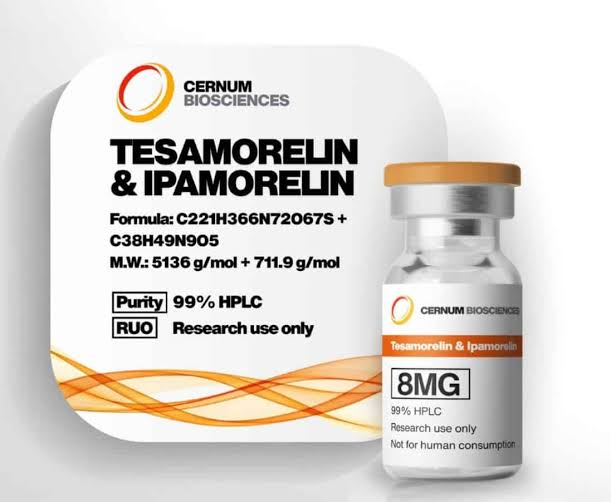
Tesamorelin peptide has become a widely discussed compound among researchers, biohackers, and beginners interested in growth hormone signaling and body composition. However, online information often blends established clinical findings with unproven claims. It is important to understand what tesamorelin is, what researchers have observed, and how to evaluate a research-grade product.
This guide explains how tesamorelin works, its potential benefits, major research limitations, and the practical steps involved in sourcing tesamorelin responsibly. Tesamorelin sold for laboratory research is not the same as an approved prescription product and should not be treated as one.
What Is Tesamorelin Peptide?
Tesamorelin is a synthetic analog of growth hormone-releasing hormone, also called GHRH. Tesamorelin interacts with receptors in the pituitary gland and can increase the release of the body’s own growth hormone.
Prescription tesamorelin is FDA approved for reducing excess abdominal fat in adults with HIV-associated lipodystrophy. It is not approved as a general weight-loss product. Most strong human evidence comes from a specific clinical population, not healthy adults seeking cosmetic fat loss.
Tesamorelin Acetate
Suppliers may list the compound as tesamorelin acetate. Acetate is the counterion associated with the peptide. Researchers should check whether a label refers to total powder weight, tesamorelin acetate, or the equivalent amount of tesamorelin base. These figures may not be identical.
Tesamorelin vs HGH
Tesamorelin and human growth hormone influence the same hormonal system, but they work at different points. HGH provides growth hormone directly. In contrast, tesamorelin signals the pituitary gland to release endogenous growth hormone.
Therefore, tesamorelin requires a functioning pituitary response. Still, both approaches can affect IGF-1, glucose regulation, fluid balance, and other growth hormone-related processes.
How Does Tesamorelin Work?
Tesamorelin binds to GHRH receptors in the pituitary gland. This increases growth hormone secretion and stimulates insulin-like growth factor 1, or IGF-1.
Growth hormone and IGF-1 influence fat metabolism, tissue growth, glucose handling, and body composition. This mechanism explains the interest in visceral fat reduction and why broader anti-aging or muscle-building claims require caution.
Tesamorelin does not directly “burn” fat in the simple way that marketing language often suggests. Instead, it changes hormonal signaling that may affect how specific fat deposits behave.
Potential Tesamorelin Benefits
The evidence behind proposed tesamorelin benefits varies by outcome. The most convincing data relate to visceral abdominal fat in adults with HIV-associated lipodystrophy.
Visceral Fat Reduction
Visceral adipose tissue surrounds the internal organs. It differs from the softer subcutaneous fat found directly under the skin.
Randomized clinical trials found that tesamorelin reduced visceral fat in adults with HIV-related abdominal fat accumulation. One pooled analysis reported an average reduction of approximately 18 percent. Another major trial reported a 15.2 percent reduction in visceral adipose tissue in the tesamorelin group, compared with an increase in the placebo group.
Visceral fat reduction is the best-supported potential benefit. Healthy adults may not experience identical results.
Body Composition
Tesamorelin studies have measured waist circumference, trunk fat, lean mass, and muscle quality. Some reported favorable changes, but they do not establish tesamorelin as a proven muscle-building compound or predict results in healthy biohackers.
Liver Fat Research
Researchers have examined whether tesamorelin may affect fat stored in the liver. A randomized study found reductions in both visceral fat and liver fat over six months. A later trial in people with HIV and nonalcoholic fatty liver disease also reported reduced liver fat and less fibrosis progression over one year.
These results remain population-specific. Tesamorelin is not broadly approved for fatty liver disease, and longer-term evidence remains necessary.
Metabolic Markers
Some studies reported changes in triglycerides, cholesterol ratios, adiponectin, or liver enzymes. However, tesamorelin can also affect glucose regulation. Researchers should not present it as a universal metabolic health solution.
Anti-Aging and Recovery Claims
Tesamorelin frequently appears in discussions about anti-aging, recovery, sleep, and performance because it increases growth hormone and IGF-1 signaling.
However, biological plausibility is not the same as clinical proof. Current evidence does not establish tesamorelin as a longevity treatment, general recovery aid, or performance enhancer. Long-term IGF-1 elevation may also carry risks that researchers do not fully understand.
Tesamorelin Research Limitations
The strongest tesamorelin studies involved adults with HIV-associated lipodystrophy. Their hormonal status, medication use, metabolic health, and fat distribution may differ from those of healthy adults.
In addition, a reduction in visceral fat does not necessarily create major weight loss. FDA prescribing information describes tesamorelin as weight neutral and states that it is not intended for general weight management.
Researchers should also separate an approved medication from a research-use peptide. FDA approval applies to a specific product and indication. It does not extend to tesamorelin sold online by unrelated suppliers.
Tesamorelin Safety and Side Effects
Because tesamorelin affects the growth hormone and IGF-1 axis, safety deserves careful attention.
Reported concerns include elevated IGF-1, fluid retention, joint discomfort, muscle pain, swelling, carpal tunnel symptoms, injection-site reactions, hypersensitivity, and impaired glucose control. FDA prescribing information also warns about diabetes risk and advises glucose monitoring during approved medical treatment.
Prescription tesamorelin is contraindicated during pregnancy, in active malignancy, and in people with certain pituitary or hypothalamic disorders. These warnings show why online protocols and casual self-experimentation can be unsafe.
A research-use vial should never be assumed sterile or suitable for human administration. High HPLC purity does not prove sterility, accurate content, or clinical suitability.
How to Source Tesamorelin for Research
A reliable tesamorelin supplier should offer more than an attractive website and a “99% purity” claim. Researchers need evidence that connects the tested sample to the product they receive.
Check the Certificate of Analysis
Start with a batch-specific Certificate of Analysis, or COA. The report should include:
- Product name
- Matching batch or lot number
- Testing date
- Laboratory name
- HPLC purity data
- Mass spectrometry results
- Report or verification number
Avoid suppliers that reuse one generic report for every batch. A COA only adds meaningful confidence when it matches the vial or batch offered for sale.
Understand HPLC Purity
High-performance liquid chromatography, or HPLC, separates the target peptide from detectable related impurities. A 99 percent HPLC result usually means the main chromatographic peak represented about 99 percent of the detected peak area. HPLC remains one of the most widely used methods for separating and assessing synthetic peptides.
However, this does not necessarily mean that 99 percent of the powder’s weight is tesamorelin. Water, salts, counterions, residual solvents, and other materials may still contribute to the vial’s total mass.
Confirm Identity With Mass Spectrometry
Mass spectrometry checks whether the sample has the expected molecular mass. Therefore, it helps confirm that the primary material is consistent with tesamorelin.
HPLC and mass spectrometry serve different purposes. HPLC mainly evaluates detectable purity, while mass spectrometry supports identity confirmation. Scientific recommendations for synthetic peptide analysis advise confirming peptide identity through mass spectrometry.
Ask About Peptide Content
Purity and quantity are not the same. A sample can show high chromatographic purity while containing less tesamorelin than the vial label claims.
For quantitative experiments, ask how the supplier confirms net peptide content. Stronger methods may include amino acid analysis, quantitative HPLC against a qualified reference standard, or another validated content assay. NIST reference materials demonstrate how laboratories may combine HPLC, amino acid analysis, and other analytical methods when assigning peptide content.
Prefer Independent Testing
Third-party testing can reduce conflicts of interest, but only when researchers can verify it.
Look for a named laboratory, a complete report, a unique test number, and a direct verification method. Also check whether the batch number on the report matches the product label.
Review Storage, Shipping, and Supplier Conduct
Peptides can degrade through heat, moisture, oxidation, and repeated temperature changes. A responsible supplier should provide clear storage guidance, secure packaging, and traceable shipping.
Positive signs also include clear contact details, realistic scientific language, batch-specific testing, and visible research-use restrictions. Warning signs include medical promises, human dosing advice, guaranteed fat-loss claims, copied COAs, and missing lot numbers.
Practical Tesamorelin Sourcing Checklist
Before ordering tesamorelin peptide for laboratory research, confirm that:
- The product is clearly labeled for research use.
- The COA matches the current batch.
- HPLC and mass spectrometry data appear complete.
- The testing laboratory can be independently verified.
- The supplier explains peptide content, not only purity.
- Storage and shipping information is clear.
- The website avoids unsupported medical promises.
- Support staff answer technical questions without giving human-use instructions.
If several points remain unclear, consider another supplier.
Final Thoughts on Tesamorelin Peptide
Tesamorelin peptide has a stronger clinical evidence base than many compounds discussed in biohacking communities. Research supports its ability to reduce visceral abdominal fat in adults with HIV-associated lipodystrophy. Studies have also explored liver fat, body composition, and metabolic markers.
However, these results do not prove that tesamorelin provides general weight loss, anti-aging, muscle growth, or performance benefits in healthy adults. The compound also affects powerful hormonal pathways and carries meaningful safety considerations.
For laboratory researchers, sourcing quality matters as much as understanding the science. Focus on batch-specific documentation, HPLC purity, mass spectrometry identity, net peptide content, independent testing, and supplier transparency. A clear verification process offers far more value than marketing language alone.
