
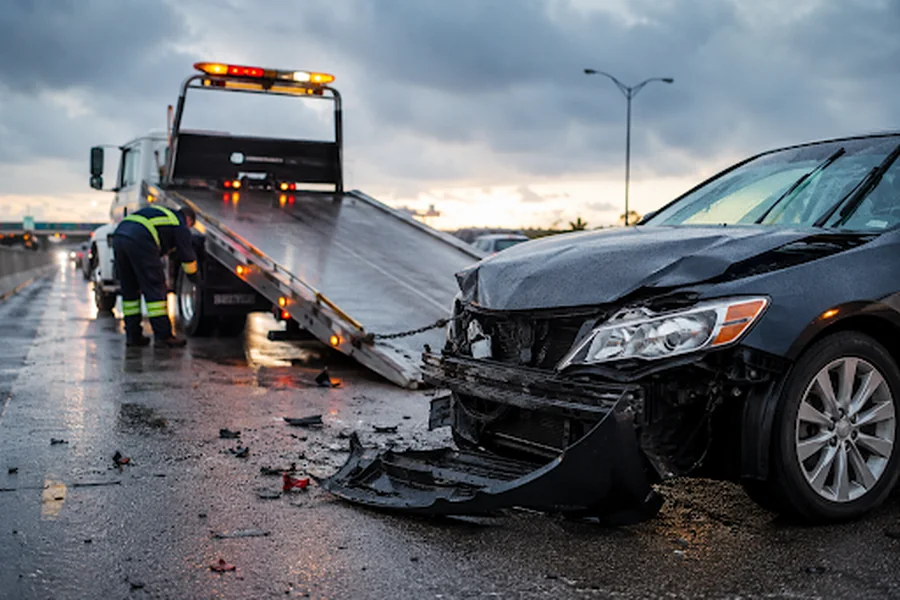
A roadside recovery vehicle is usually associated with help after a breakdown or collision. That can make an accident involving one especially confusing for an injured driver or passenger. The circumstances can be unusual because the vehicle may be stopped on a shoulder, loading another automobile, responding to an emergency call, or traveling with a disabled vehicle attached. A collision can also involve more than one driver, commercial insurance policies, towing equipment, maintenance records, and questions about how the disabled vehicle was secured. Understanding what happened and identifying every factor behind the crash can make a significant difference when pursuing compensation for injuries and financial losses.
Why Roadside Recovery Truck Crashes Require More Than a Basic Accident Review
Tow trucks operate in situations that are already dangerous. They frequently arrive at disabled vehicles, previous crashes, congested roads, narrow shoulders, and high-speed highways. A passing motorist may not recognize a stopped recovery vehicle until it is too late. At the same time, a tow operator can create a collision by changing lanes improperly, following too closely, driving while distracted, speeding, or failing to secure the vehicle being transported. The equipment itself can also become part of the investigation.
A damaged winch, failed connection, defective strap, malfunctioning light, or improperly maintained component may help explain why the crash occurred. Leading legal resources on this subject consistently emphasize that these cases can involve multiple parties and different theories of responsibility rather than a simple driver-versus-driver dispute. That distinction matters because an early assumption about fault may overlook another responsible party.
The Different Ways a Tow Truck Collision Can Happen
Not every crash involving a recovery vehicle happens in the same way. The location, movement of the vehicles, towing method, traffic conditions, and actions of the people involved can all change the legal analysis. A moving tow truck may collide with another vehicle while traveling to a service call. A stopped truck may be struck while an operator is working beside a disabled automobile.
A vehicle being transported may shift, detach, or fall into the roadway and cause another driver to lose control. There can also be secondary collisions when traffic approaches an unexpected obstruction too quickly. This is one reason investigators need to reconstruct the sequence of events instead of looking only at the final point of impact.
Who May Be Responsible for the Injuries and Property Damage
Liability depends on the facts and the applicable state law. The tow operator may be responsible if negligent driving or unsafe towing practices contributed to the crash. The towing company may also face liability depending on the employment relationship, company policies, maintenance practices, training, supervision, or other circumstances. In some cases, a vehicle owner, repair company, equipment manufacturer, or maintenance contractor may become relevant.
A government agency or road authority could also be involved when roadway conditions contributed to the collision, although claims against public entities often have special rules and deadlines. Some crashes involve another motorist whose conduct created the original roadside emergency or caused the tow truck to stop in a hazardous location. Because several parties may have separate insurance coverage, determining responsibility early can prevent an important avenue of recovery from being overlooked.
The Evidence That Can Tell the Real Story
Physical evidence can disappear quickly after a roadside crash. The damaged vehicles may be repaired or moved, surveillance footage may be overwritten, and electronic records may become harder to obtain. For that reason, a thorough investigation should examine more than photographs of the accident scene.
Important evidence may include:
- Police reports and crash diagrams.
- Photographs and videos from the scene.
- Dashcam or nearby surveillance footage.
- Tow dispatch records and service-call information.
- Vehicle inspection and maintenance records.
- Driver training and employment records when legally relevant.
- Towing contracts and equipment documentation.
- Statements from witnesses and other motorists.
- Photographs showing road conditions, warning lights, lane positioning, and vehicle damage.
- Records concerning the vehicle being towed.
The precise evidence available will depend on the accident, but the central goal is the same. Investigators need to establish what each vehicle was doing immediately before the impact and why the collision became unavoidable.
What an Investigation Should Establish Before Fault Is Assigned
A strong investigation does not begin with the assumption that one person is automatically responsible. Instead, it examines the sequence of events from several angles. For example, imagine a recovery truck stopped on a highway shoulder while its operator is attaching a disabled car. Another driver leaves the travel lane and strikes the truck. At first glance, the passing driver may appear responsible. But investigators may still need to determine whether the tow truck had appropriate warning lights, whether the operator was positioned safely, whether the disabled vehicle was adequately secured, and whether the location created an unusual hazard.
The opposite situation can also occur. A tow operator may be moving between lanes while carrying another vehicle and collide with a passenger car. In that situation, the investigation may focus more heavily on speed, lane positioning, visibility, following distance, signaling, and towing procedures. This fact-based approach is one of the most important distinctions between a basic accident report and a comprehensive injury investigation.
How a Tow Truck Accident Lawyer Can Strengthen a Claim
A Tow truck accident lawyer can investigate the collision while also evaluating the legal issues surrounding liability and damages. The work may begin with preserving evidence and obtaining available reports. The attorney may then review photographs, medical records, insurance information, witness statements, vehicle damage, and commercial records connected with the towing operation. Where necessary, lawyers may work with accident reconstruction professionals or other qualified experts to understand vehicle movement, impact dynamics, visibility, or equipment failure.
The attorney can also handle communications with insurers. That matters because insurance companies may focus on minimizing their financial exposure, while an injured person may still be dealing with medical treatment, missed work, vehicle damage, and uncertainty about future expenses. Legal representation can help keep the claim focused on documented losses and the evidence supporting responsibility.
Compensation May Extend Beyond the Initial Medical Bill
The financial impact of a serious collision can continue long after the vehicles leave the repair shop. Depending on state law and the circumstances of the case, an injured person may seek compensation for medical treatment, rehabilitation, lost income, reduced earning capacity, property damage, and certain non-economic losses. The value of a claim cannot be determined accurately from the emergency-room bill alone.
A person with a significant injury may require follow-up appointments, physical therapy, prescription medication, diagnostic testing, or long-term care. Lost income can also become substantial when an injury prevents someone from returning to work or limits the type of work they can perform. Non-economic damages may apply in qualifying cases, but the rules and available categories differ considerably between states. That is why compensation should be evaluated using the complete picture of the injury rather than an early settlement offer.
What to Do After a Collision Involving a Recovery Vehicle
The first priority after any serious crash is safety and medical attention. Once immediate safety concerns are addressed, preserving useful information can help later. Avoid guessing about fault at the scene. A simple statement made under stress can sometimes be misunderstood when an insurance company reviews the claim later. If physically able, document the vehicles, roadway, traffic controls, warning lights, visible towing equipment, and surrounding conditions.
Obtain the responding agency’s information and collect contact details for witnesses when possible. Medical evaluation is also important even when an injury does not initially appear severe. Some injuries become more noticeable after the immediate shock of a collision subsides. Keeping records of treatment, expenses, missed work, and other accident-related losses can also make the financial impact easier to document.
The Biggest Mistake Is Treating the Crash Like an Ordinary Fender-Bender
A tow truck collision can look straightforward at the scene and become much more complicated during the claim process. Commercial vehicles may involve business owners, employees, contractors, equipment providers, and multiple insurance policies. The vehicle may also have been performing a specific roadside service when the crash occurred. Those circumstances can introduce questions that do not arise in an ordinary passenger-car collision.
Another problem is assuming that the first insurance company that contacts the injured person represents the full picture of available coverage. There may be additional parties or policies that need to be investigated. A careful review before accepting a settlement can therefore be important, particularly when injuries are serious or future treatment is uncertain.
How to Evaluate Your Legal Options Without Guesswork
The right legal strategy depends on the facts, the location of the accident, the severity of the injuries, and the applicable limitation period. A lawyer reviewing the case should be able to explain who may be responsible, what evidence should be preserved, what damages may be available, and what deadlines apply.
It is also reasonable to ask how the attorney handles commercial vehicle investigations and cases involving towing operations. A useful consultation should leave you with a clearer understanding of the strengths and weaknesses of the claim rather than promises about a particular financial result. No responsible attorney can guarantee a specific settlement or verdict because every accident depends on its own evidence and legal circumstances.
Conclusion
A collision involving a roadside recovery vehicle can raise questions that are easy to miss in the first few hours after an accident. Driver conduct, towing procedures, equipment condition, roadway positioning, commercial relationships, insurance coverage, and the actions of other motorists may all affect the outcome. The most useful approach is to preserve evidence, document injuries and losses, avoid premature assumptions about fault, and obtain advice based on the specific facts of the collision. When injuries are serious or multiple parties may be responsible, professional legal guidance can help ensure that important evidence and potential sources of compensation receive proper attention.
