
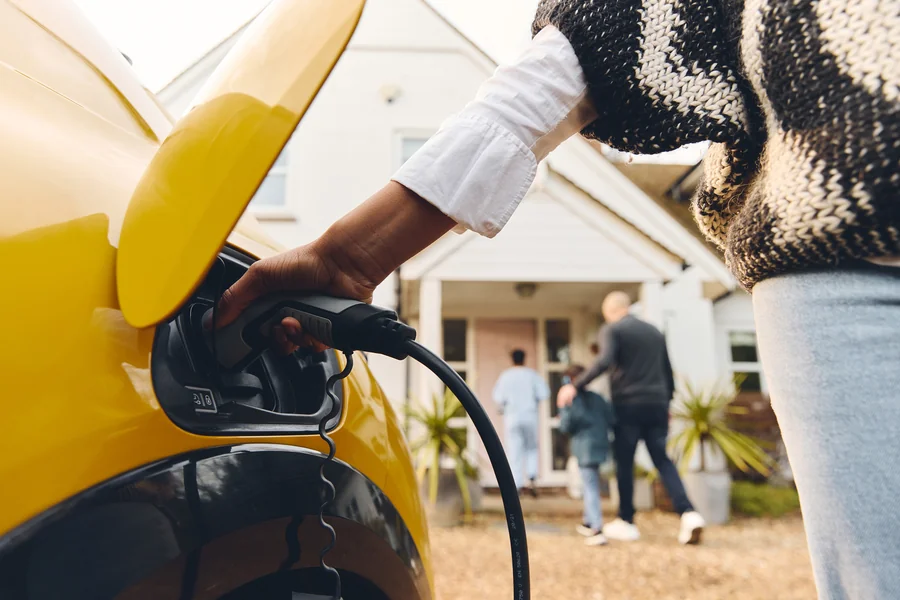
Most people shopping for an electric car in Naperville ask the same question once the excitement wears off: what happens to the electric bill? It’s a fair worry. A car is the second-biggest thing most households plug in, after the air conditioner, and nobody wants a surprise the first full month.
The honest answer is that it depends on two things you actually control: how much you drive, and when you charge. Get the timing right with ComEd’s rate options and the damage is smaller than people expect. Get it wrong and you’re paying peak prices to fill a battery overnight, which is a little like buying gas at the most expensive station in town out of habit.
Here’s the math, using ComEd’s 2026 numbers.
First, how much electricity does an EV actually use?
A car battery sounds enormous, but daily charging is modest. The average American drives about 37 miles a day. A typical mid-size EV travels roughly three to four miles per kilowatt-hour, so that daily commute pulls something like 9 to 12 kWh out of the wall.
Over a month that lands most Naperville drivers between 250 and 350 kWh of added consumption. Lighter drivers come in lower. People with a long highway commute or a heavy truck like an F-150 Lightning run higher. For the rest of this article the example uses 300 kWh a month, which is a reasonable middle for one car in a typical household.
For comparison, the U.S. Energy Information Administration puts the average Illinois home around 700 kWh a month. So a single EV adds roughly 40% to a typical household’s usage. That number scares people, but the dollar figure is what matters, and the dollar figure is very sensitive to which rate you’re on.
ComEd’s flat rate: the do-nothing baseline
If a Naperville driver does nothing special and stays on ComEd’s standard residential rate, every kilowatt-hour costs the same no matter the hour.
Two pieces make up that price. There’s the supply charge, which covers the electricity itself, and the delivery charge, which covers moving it to the house. For the summer 2026 period, ComEd’s supply rate is about 10.6 cents per kWh, and traditional delivery runs roughly 5.9 cents per kWh. Add taxes and small riders and the all-in retail price sits around 16 to 17 cents per kWh.
At 300 kWh a month, that works out to roughly $50 added to the monthly bill. Call it $600 a year for the car.
That’s the baseline. It’s also the most expensive way to do it, because it treats 2 a.m. and 5 p.m. as if they cost the same, and they don’t.
The time-of-use option: charge when the grid is quiet
This is where the real savings live, and it’s the part most new EV owners skip.
Starting in June 2026, ComEd offers a Delivery Time-of-Day (DTOD) rate built specifically to reward people who shift their usage off the busy hours. The day is split into windows:
- Morning: 6 a.m. to 1 p.m.
- Mid-Day Peak: 1 p.m. to 7 p.m.
- Evening: 7 p.m. to 9 p.m.
- Overnight: 9 p.m. to 6 a.m.
Delivery costs the most during that mid-day and early-evening stretch, when air conditioners and offices are all pulling at once, and the least overnight when demand drops off. The exact rate for each window depends on the home’s delivery class, which ComEd ties to heating type, so the precise cents-per-kWh varies house to house. The pattern, though, is the same everywhere: overnight is cheap.
For an EV owner, this is close to ideal, because charging is the one big load that doesn’t care what time it happens. The car sits in the garage all night anyway. Plug it in, schedule it to start after 9 p.m., and the most expensive part of the bill simply moves to the cheapest window.
There’s a second sweetener. ComEd gives DTOD customers who enroll an EV a $2 monthly credit per vehicle, for up to 24 months and up to two cars. It’s not life-changing money, but it’s real, and it knocks the effective charging cost down a little further.
Run the same 300 kWh a month through off-peak delivery pricing and the all-in cost typically falls into the 11 to 12 cents per kWh range, sometimes lower depending on the delivery class. That’s roughly $33 to $36 a month before the credit, and about $31 to $34 after it.
So what’s the gap?
Same car. Same miles. The difference is purely timing.
| Flat rate (do nothing) | Off-peak time-of-use | |
| Effective price per kWh | ~16–17¢ | ~11–12¢ |
| Monthly cost (300 kWh) | ~$50 | ~$33 |
| EV bill credit | none | –$2/month per vehicle |
| Net monthly | ~$50 | ~$31–34 |
That’s somewhere around $16 to $19 a month, or roughly $200 a year, kept in your pocket for the price of setting a charging schedule once in the car’s app. Drivers with two EVs, or anyone doing more than average mileage, see the gap widen further.
It’s worth saying plainly: ComEd’s supply prices have climbed a lot recently, mostly because of a regional capacity auction that pushed rates up across its territory. That makes the timing question more important, not less. When the per-kilowatt-hour price is high, the percentage you save by moving to off-peak is the same, but the dollars are bigger.
Why the charger itself matters here
A scheduled charge only helps if the equipment can actually deliver overnight. A standard wall outlet (Level 1) adds three to five miles of range per hour, which often isn’t enough to refill a daily commute in the nine-hour overnight window. A Level 2 charger runs six to eight times faster, so the car comfortably tops up before morning and all of that energy lands in the cheap window.
That’s the practical link between hardware and the bill. The rate plan saves money on paper, but a Level 2 setup is what lets a Naperville household actually capture it night after night. ComEd also offers residential rebates of up to $2,500 toward a Level 2 install, with a condition that ties directly to this whole discussion: you enroll in a time-of-use or hourly pricing plan and stay on it. The utility is essentially paying people to charge at the right time.
Installation does need to be done by an Illinois Commerce Commission–certified provider to qualify for that rebate, which is one reason it’s worth working with a local electrician who handles EV charging station installation regularly rather than treating it as a weekend project. Panel capacity, circuit sizing, and permitting in Naperville all factor in, and a botched install can cost more than the rebate is worth.
A few honest caveats
Time-of-use isn’t free money for everyone. If a household’s daytime usage is heavy already (someone home running the AC and appliances through the afternoon peak), the higher peak delivery charge can eat into the overnight savings. The rate rewards people who can genuinely shift load, and an EV is one of the easiest loads to shift, but the rest of the home’s habits matter too.
The numbers here are also estimates. Delivery class, monthly adjustments, and seasonal supply changes all move the exact figure around. The smart move is to log into a ComEd account and use the Rates Comparison tool, which models a specific home against the different plans using actual usage. That beats any blog estimate, this one included.
The short version
For most Naperville drivers, one EV adds somewhere between $30 and $50 a month to the ComEd bill. The spread between those numbers is almost entirely about when the charging happens. Set the car to charge overnight, get on a time-of-use rate, and the car becomes one of the cheaper things in the house to run, well under what the same miles would cost in gasoline.
The piece people underestimate is the hardware. The rate plan is the strategy; a proper Level 2 charger is what makes it work. If you’re weighing an install and want it done to code and rebate-eligible, it’s worth talking to a licensed local team before buying a car, not after the first painful bill arrives.
